I did not start in Kubernetes. I started in browser tabs, game loops, and a makerspace that smelled like hot PLA. This post is the longer version of that path—backend, platform, and DevSecOps are where I landed, but the steps in between matter. Version française.
The arc (one glance)
Career flow (career-journey-flow.mmd, rendered with uml-mcp):

Figure: milestones from browser games and makerspace demos through ÉTS capstones, co-ops, and today’s platform/backend focus. Rendered from career-journey-flow.mmd.
Color key: green personal · blue school · purple club · gray co-op · slate full-time job · orange contract · pink teaching · amber today.
The diagram is the map; the sections below are the stories I tell in interviews when someone asks “how did you end up doing platform work?”
~2010 — Game developer energy, Flash and the web
In high school I was already building small browser games in Flash and picking up HTML and JavaScript. Progress meant something you could click: a loop that runs, a score that updates, a page that loads without embarrassing you in front of friends.
That habit—ship something playable, then fix what feels wrong—never really left. Years later I packaged some of that nostalgia as FlashGames (Ruffle in the browser) and a https://antoineboucher.info/CV/blog/projects/retroarch-web-games/ Docker setup for classic consoles.
~2015 — A game portfolio, then bigger engines
By college I was curating a portfolio of game projects and redoing favorites in Unity, CryEngine, and Unreal. Same motivation, heavier tools: lighting, physics, assets that take a week to look “fine.”
It taught me scope. A jam game and a semester demo do not owe each other the same bar—but both owe you honest playtesting.
That scope sense shows up later when I refuse to boil the ocean on a single microservice migration — I want a playable milestone every week.
~2017 — Makerspace, WiFi RC, web as a serious path
At Collégial International Sainte-Anne I managed the makerspace: 3D printers, VR gear, students stuck on wiring at 4 p.m. on a Friday. I also built a WiFi-controlled RC car—the kind of project where firmware, mechanical slack, and “why does it only steer left?” share the same afternoon.
That year I leaned into web development for real: less “scene in a game engine,” more “product someone uses every week.”
2018 — Algolux internship (computational imaging)
My Algolux internship was five weeks inside computational photography: Python tools, RAW color analysis, capture workflows, Ansible stacks for ISP validation. I still have the research poster from that period—it is the bridge between “I like code” and “I like systems that touch the physical world.”
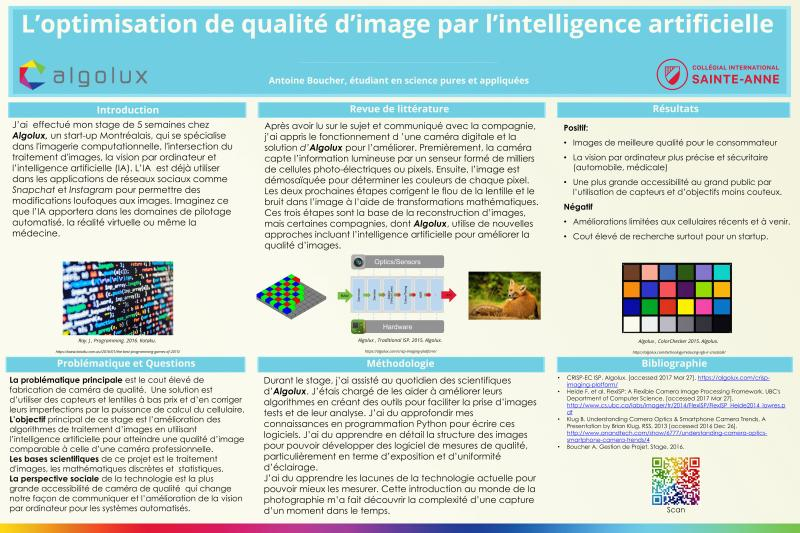
Concrete leftovers on this site: https://antoineboucher.info/CV/blog/projects/rawanalyser/ (RAW clipping and calibration helpers, Algolux-era lineage). Lab work was spreadsheets, cameras, and scripts—not shiny product pages—but it trained the same loop I use today: measure, automate, document.
ÉTS — Hydroglisseur, AlgoÉTS, and the web stack
École de technologie supérieure (ÉTS) is where school projects stacked into something like a career.
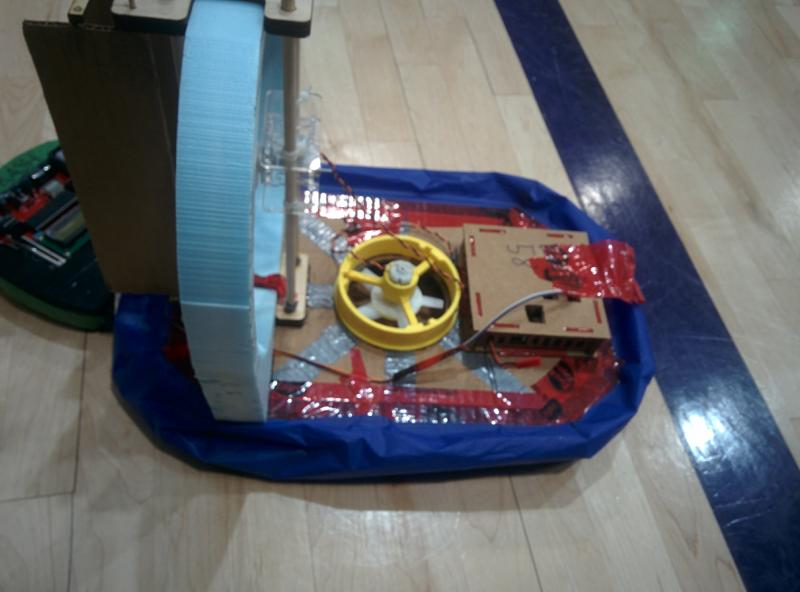
Technological path (2017–2018) — capstone hydroglisseur (hovercraft): blue skirt, lift fan, 3D-printed parts, wood and foam and stubborn debugging. The kind of build that teaches integration before microservices.
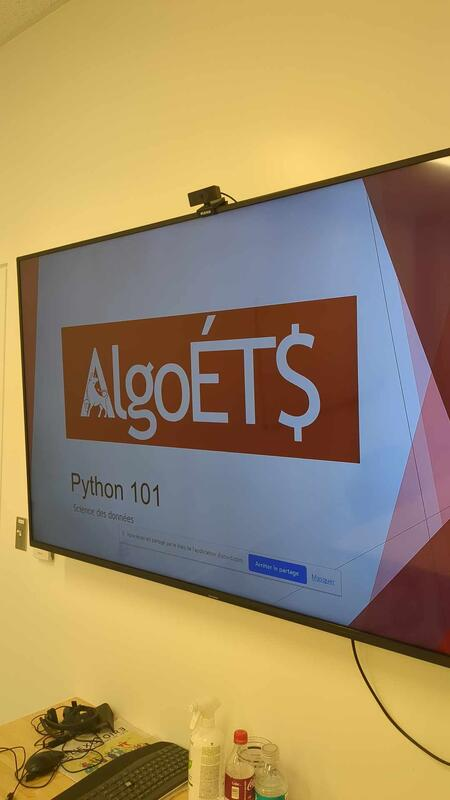
Bachelor (2018–2023) — coursework plus clubs. I helped run AlgoÉTS (algorithmic trading); we ran workshops like Python 101 for data science for members who wanted to move from “I use Python” to “I trust my pandas.”
That club work connects to open source I still maintain: the https://antoineboucher.info/CV/blog/projects/marketwatch/ Python library for the stock-market game. Same itch—automate the boring path so humans can focus on decisions.
Co-ops (2019–2022) — Wandrian, Power Go, Intact: parsers, APIs, ELK dashboards, and backend work where the titles finally matched the daily grind.
Full-time (2023) — IONODES: cloud developer on an IoT platform—Auth0 tiers, Sentry, ONVIF/WebRTC, Azure DevOps.
Master (2023–2026) — ÉTS: real-time rendering, interactive physics, and surface wear in real time, with dynamic friction and textures—the thread that ties graphics back to the path.
2020s — Platform, security, teaching
After graduation the problems moved up a layer:
- GitLab CI/CD, GCP, Java microservices, Playwright tests (IMC2 research).
- DevSecOps labs at Polytechnique Montréal—GitLab templates for ~20 teams, Docker/Kubernetes, OWASP-minded reviews.
- Teaching at ÉTS: distributed databases, mobile UX labs, integrator projects—courseware is also software delivery.
- https://antoineboucher.info/CV/blog/posts/graphquon-2024-ets/ conference web (graphquon.github.io) and uml-mcp for diagrams from chat—because explaining systems still beats guessing them.
What stayed constant (the “human” part)
Early on I measured progress in features shipped. Now I care whether the system stays understandable when you are not in the room:
- Backend — boundaries, failure modes, APIs that do not surprise the next team.
- Platform — CI, logging, local dev that works without a heroic README.
- DevSecOps — secrets, dependencies, and deploy paths that are boring on purpose.
Reliability is trust. Security is not a final gate—it is habits in the pipeline. I still write posts and draw flows because explaining something badly is how I notice what I do not understand.
What I optimize for next
Sharper platforms, safer delivery, legible systems as they grow. If you are early in the path: follow problems where you see the whole loop—code, deploy, operate, improve. I happened to start that loop with Flash and a hovercraft; you might start somewhere else. The loop is the job.
More concrete write-ups live under posts and projects on this site.
Related posts
- GraphQuon 2024 — ÉTS and GraphQuon 2025 — Toronto — graphics research community
- CodePen demos — early web experiments
- Professional résumé + JSON Resume — how this timeline becomes a CV