I wanted scale readings in Home Assistant next to the rest of my apartment automations — not another siloed health app. That turned into maintaining hass_renpho (a fork of the quiet community integration), running APKLeaks on the Android client, and a Lovelace board I still open when training or sleep changes. Version française.
Why not only the Renpho app
A Renpho scale with bio-impedance spits out more than weight — BMI, BMR, body age, fat and muscle estimates, water, protein, visceral-fat indices, and a pile of resistance fields per limb if you pull the full payload. Useful only if the numbers live where you already look: history graphs, automations, and the same homelab mindset as everything else self-hosted at home.
Inspiration (without the cult)
Personal tracking, for me, started around the same time people were talking about Bryan Johnson’s “Blueprint” push for self-quantification. I am not selling a protocol — the point was simpler: trends over time, same conditions, don’t panic on one morning spike. The photo below is mood board energy, not medical advice.

Where hass_renpho came from
Neil Allen’s write-ups — reverse-engineering the Renpho app and Renpho → Home Assistant — did the hard thinking first. The community repo neilzilla/hass-renpho wrapped that into a Home Assistant custom component.
When activity slowed and I needed more entities exposed, I forked to antoinebou12/hass_renpho. The README is honest about constraints:
This integration targets the older Renpho app cloud API. Newer app versions may not work; treat it as a hobby integration, not a supported product.
There is a small API explorer at hass-renpho.vercel.app/docs if you want to poke the JSON with your own credentials before touching HA.
What the fork actually does
- Logs into Renpho’s cloud (
renpho.qnclouds.com) with email/password (same as the phone app). - Polls on a
refreshinterval you set in YAML or the UI. - Exposes sensors for weight, composition, metabolic estimates, device metadata, and optional girth/goals when the account has them.
- Optional
proxyURL when your home IP is throttled or blocked but the app works on cellular data.
I kept talking with the original maintainer when it made sense — share payload shapes, avoid duplicate fixes, keep one integration useful for anyone else with a scale in the closet.
Install path I used
- HACS on Home Assistant (or copy
custom_components/renphofrom the repo). - Drop credentials in
configuration.yaml(legacy platform style in my fork):
renpho:
  email: [email protected]
  password: !secret renpho_password
  refresh: 600  # seconds between polls — logging in here can log you out of the app
  # proxy: http://127.0.0.1:8080  # optional — only this integration’s traffic

sensor:
  - platform: renpho
- Restart HA, confirm entities appear, then build Lovelace.
Heads-up: polling logs you into the cloud API; Renpho may kick your phone session. I picked a 600s refresh so I was not hammering login on every automation tick.
Metrics the integration surfaces
The fork documents dozens of fields. In practice I watch a smaller set in Lovelace; the rest are there if you automate or debug.
| Group | Examples | Units |
|---|---|---|
| Core | weight, BMI, body fat, water, muscle, bone | kg, % |
| Shape | waistline, hip, stature | cm |
| Metabolic | BMR, protein | kcal/day, % |
| Age | body age | years |
| Visceral / subcutaneous | visfat, subfat | level, % |
| Device | scale name, MAC, model, timezone | strings |
| Bio-impedance raw | resistance per limb (20 kHz / 100 kHz style fields) | ohms |
Full tables live in the repo README — handy when APKLeaks shows a new key and you need a matching sensor.
When the cloud API fights your network
Residential or datacenter egress sometimes fails against Renpho’s cloud even when the official app works on LTE. Symptoms: auth errors, empty lists, random HTTP failures in HA logs.
Mitigations from the README:
- VPN on the HA host — change egress IP for everything on that machine.
proxyin config — only Renpho traffic goes through your HTTP/SOCKS proxy (credentials pass through that path — use something you trust).
I document this because it burned an evening that looked like “broken integration” but was really IP reputation.
Reverse engineering with APKLeaks
Renpho does not ship a public API PDF. Next step: see what the Android APK calls.
APKLeaks scans the package for strings — hosts, paths, keys — without a full decompile session:
pip install apkleaks
git clone https://github.com/dwisiswant0/apkleaks
cd apkleaks && pip install -r requirements.txt
apkleaks -f /path/to/renpho.apk -o renpho-leaks.txt
I matched leaked URLs and parameter names to the JSON fields the integration already mapped, then filled gaps when Lovelace showed unknown for a new key after an app update.
Further reading:
Treat anything you extract as an unstable contract — store updates break custom integrations; that is the hobby tax.
Lovelace dashboards
Two views I actually use: vitals + history, then girth/goals when Renpho syncs them.
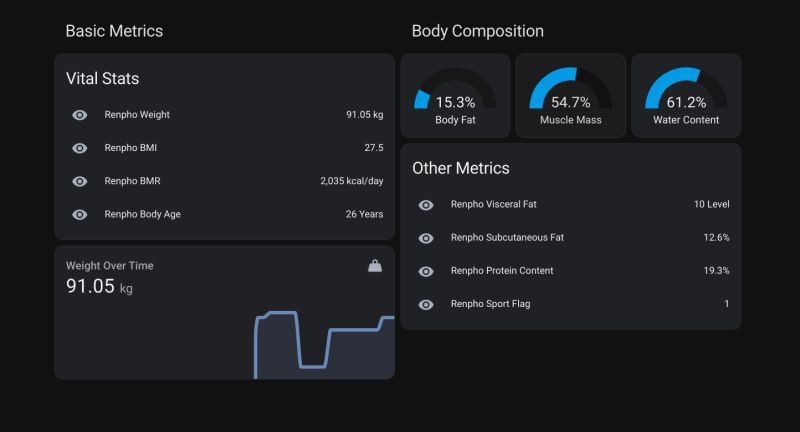
Weight trend at the top, composition gauges in the middle, “extra” metrics as entities you can hide if they noise you out.
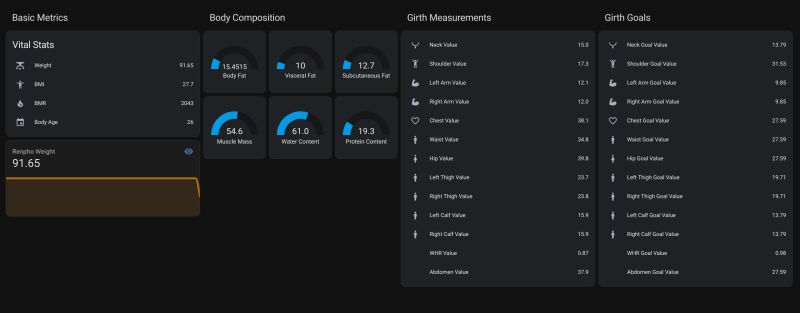
Girth and goals only matter if your Renpho profile has them; otherwise this panel stays empty and that is fine.
Context outside HA
Renpho is one input. I still mirror activity and food elsewhere (Google Health, MyFitnessPal) so scale readings sit next to movement and calories, not alone in a vacuum.
Habits that kept the series usable
| Habit | Why |
|---|---|
| Same time of day | Mornings, similar hydration — otherwise you are comparing apples to soup |
| Clothing constant | ~1 kg swing is normal noise, not “fat overnight” |
| Trends over weeks | Bio-impedance composition lags reality; react to slopes |
| Hide gauges you ignore | If you do not act on visceral fat %, remove the card |
This started as a technical side project and became a steady habit: enough signal to notice when training or sleep changes show up in weight and energy, not enough precision for clinic decisions.
When not to do this
- You need clinical body composition — consumer scales estimate, they do not diagnose.
- You cannot run the legacy app/API path the integration expects.
- You will not maintain a fork when Renpho changes the app — budget breakage.
- Daily fat % will ruin your mood — curate the dashboard ruthlessly.
Repo links (quick)
| Resource | URL |
|---|---|
| My fork | github.com/antoinebou12/hass_renpho |
| Upstream lineage | github.com/neilzilla/hass-renpho |
| API docs / playground | hass-renpho.vercel.app/docs |
| Original RE blog | neilgaryallen.dev — Renpho series |
Related posts
- Home networking evolution — same “own your infra” thread
- MediaBox homelab notes — another self-hosted stack at home
- Economics of LEGO with data science — another dataset curiosity project
If you self-host health data, what actually stuck — Home Assistant, Grafana, or phone-only apps? The gadget is rarely the hard part; fitting the routine is.