GraphQuon (formerly MOTOGRAPH) is the annual Quebec–Ontario pre-SIGGRAPH workshop for East-Canadian computer graphics labs. The 2024 edition ran 9–10 November 2024 at École de technologie supérieure (ÉTS) in Montréal. I helped build and host the conference website at graphquon.github.io so schedules, registration, and past editions stayed in one place. Version française.
What GraphQuon is for
From the site’s About the event copy: students present prospective SIGGRAPH-bound work to a friendly, constructively critical audience and get feedback before the real submission crunch. Faculty groups across Quebec and Ontario rotate hosting; 2024 was ÉTS’s turn.
Questions for organizers: [email protected].
Earlier names
| Year | Name | Dates |
|---|---|---|
| 2018 | MOTOGRAPH | Nov 17–18 |
| 2019 | MOTOGRAPH | Dec 7–8 |
| 2021 | Tomatograph | Dec 3–4 |
| 2022 | FOIEGRAPH | Nov 11–12 |
| 2023 | GRAPHQUON | Dec 2–3 |
| 2024 | GRAPHQUON | Nov 9–10 @ ÉTS |
2024 schedule (highlights)
Full timetables live on graphquon.github.io. A few anchors I remember from the published program:
Saturday 9 November
- Morning talks included Quoc-Minh Ton-That, Melissa Katz (McGill), and Ivan Puhachov (UdeM) among the honourable mentions.
- Midday ÉTS/Sherbrooke block: Justin Benoist, Arthur Delon, Joel Pelletier-Guenette.
- Afternoon: Abhishek Madan (Toronto); Clara Kim (Waterloo) won Best presentation.
Sunday 10 November
- Morning honourable mentions included Victor Rong, Ryusuke Sugimoto, Yue Chang, and Ege Ciklabakkal.
- Late afternoon ÉTS/MILA block: Alex Hoang-Cao, Darsh Kaushik.
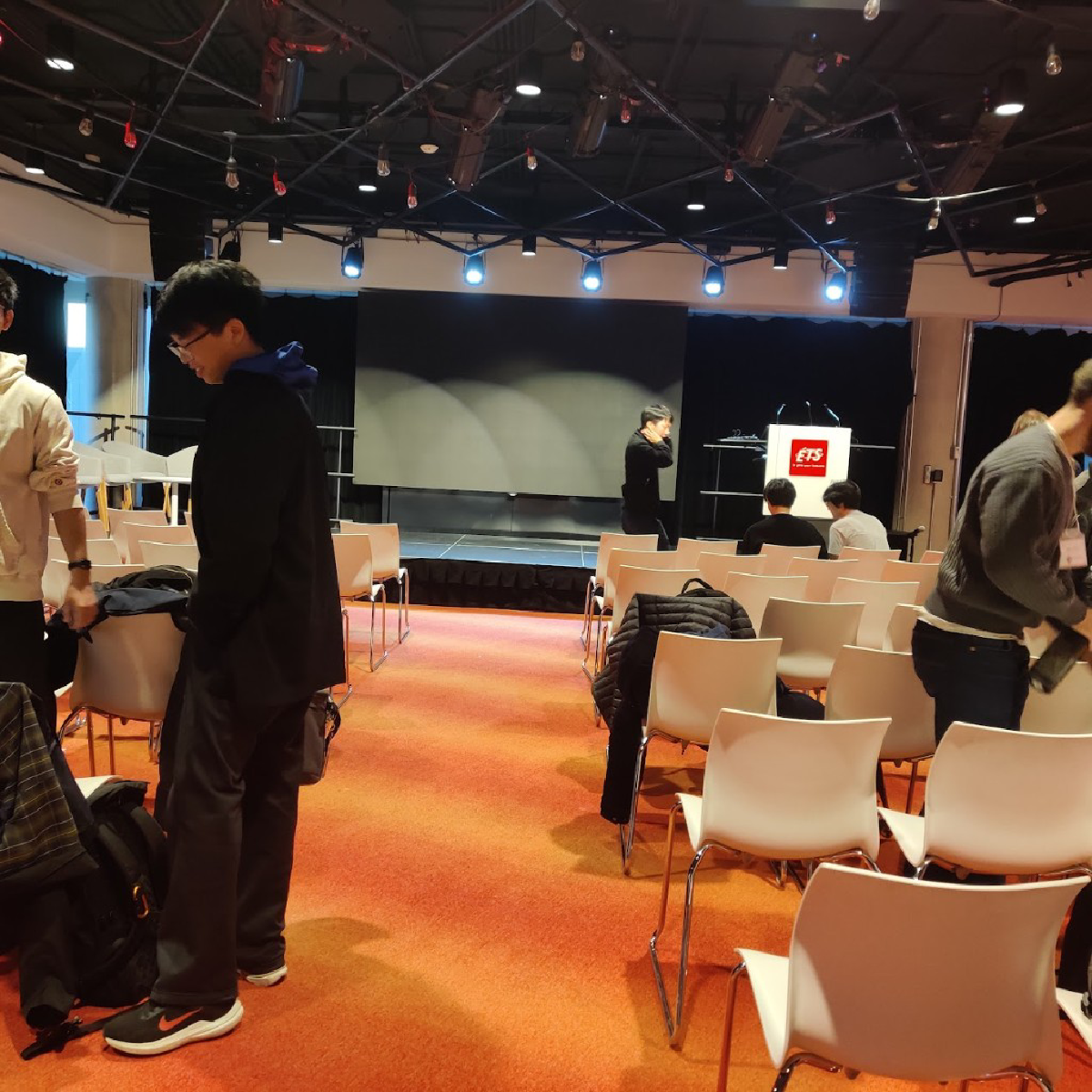
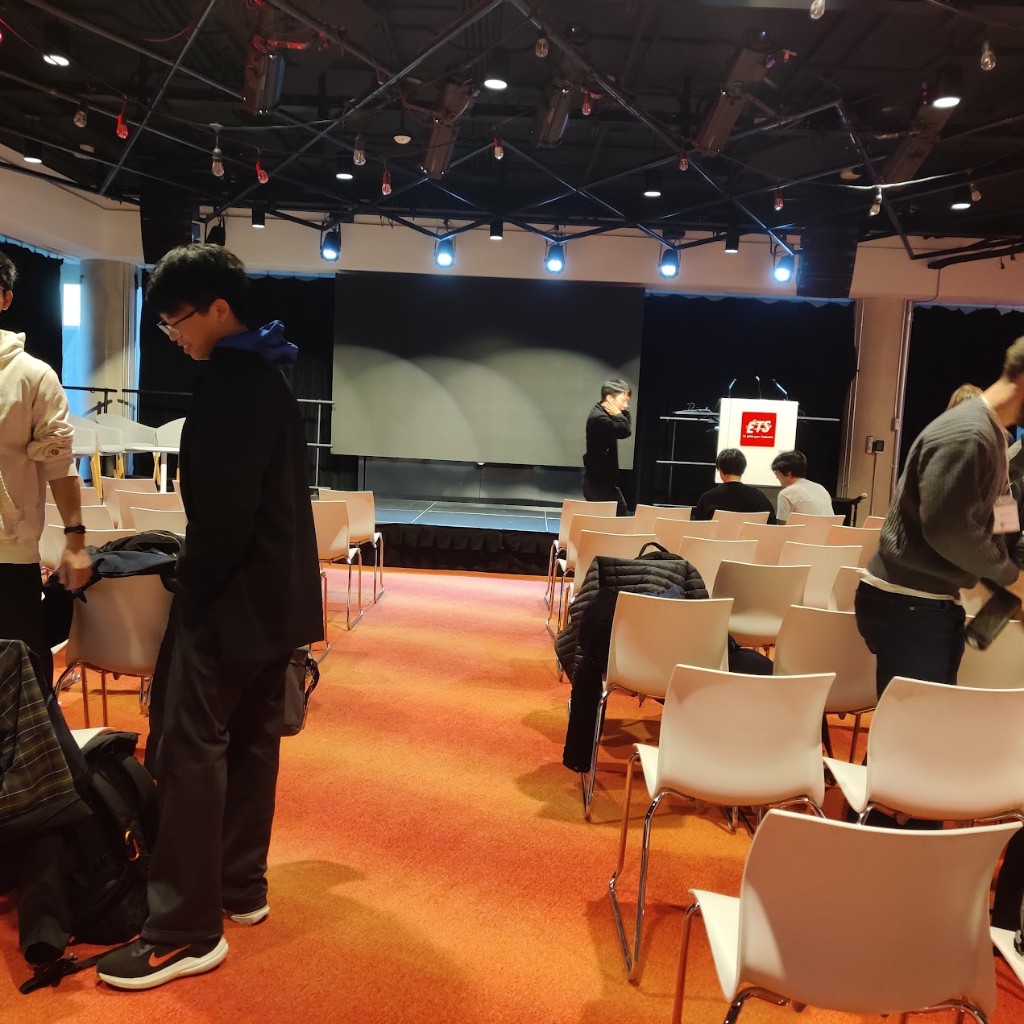
The room itself matched the workshop vibe: ÉTS auditorium, red carpet, simple stage, and a lot of white chairs filled between sessions.
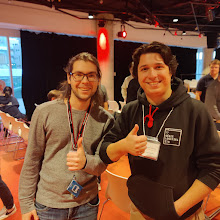
Hallway highlight: Masha Shugrina (NVIDIA)
Between sessions I talked with Masha Shugrina (NVIDIA Spatial Intelligence Lab / creative AI tools). Two demos stuck with me:
- Diffusion Texture Painting (SIGGRAPH 2024) — painting on UV-mapped meshes with a diffusion brush so strokes stay seamless and you can blend complex reference textures interactively, not just stamp pixels.
- A Gaussian-splat style environment scan — a simple scene you could walk around in, the kind of collider/scan setup that makes spatial content feel immediate without a heavy offline pipeline. (NVIDIA’s newer line of work includes Gaussian splat painting research; the booth conversation was about that direction more than a single paper title.)
It was the useful kind of industry chat: concrete tools you could imagine plugging into a lab pipeline, not a slide deck of buzzwords.
Audience and vibe
Mostly graphics + vision grad students and faculty from Quebec and Ontario — people who understand meshes and shaders but still want a friendly room. Talks skewed research-heavy; questions were about evaluation protocols and whether a method would survive a SIGGRAPH reviewer, not startup pitch decks.
My role vs 2025
For 2024 I was on the organizing/web side (site on GitHub Pages, schedule pages, contact blocks). That meant I learned the boring critical path: bios on time, PDF links that do not 404, and a schedule page that works on mobile in a hallway. In 2025 I presented at the Toronto edition — see GraphQuon 2025 — University of Toronto (Where to Wear? with Sheldon Andrews). Organizing first made presenting calmer — I already knew where the HDMI adapter lived.
Tips if you attend next year
- Bring a question for the presenters — honourable mentions get sharp feedback when they name what they want (SIGGRAPH track, clarity, eval).
- Talk in the hall — half the value is comparing pipelines with other Quebec/Ontario labs.
- Check the site early — schedules shift; graphquon.github.io is the source of truth.
Related posts
- GraphQuon 2025 — University of Toronto — presenting Where to Wear?
- Software engineering journey — ÉTS thread